
10th Best Small Company in the UK: Warranty First Best Companies Case Study
In 2025, the UK's 10th Best Small Company to Work For Had No HR Department
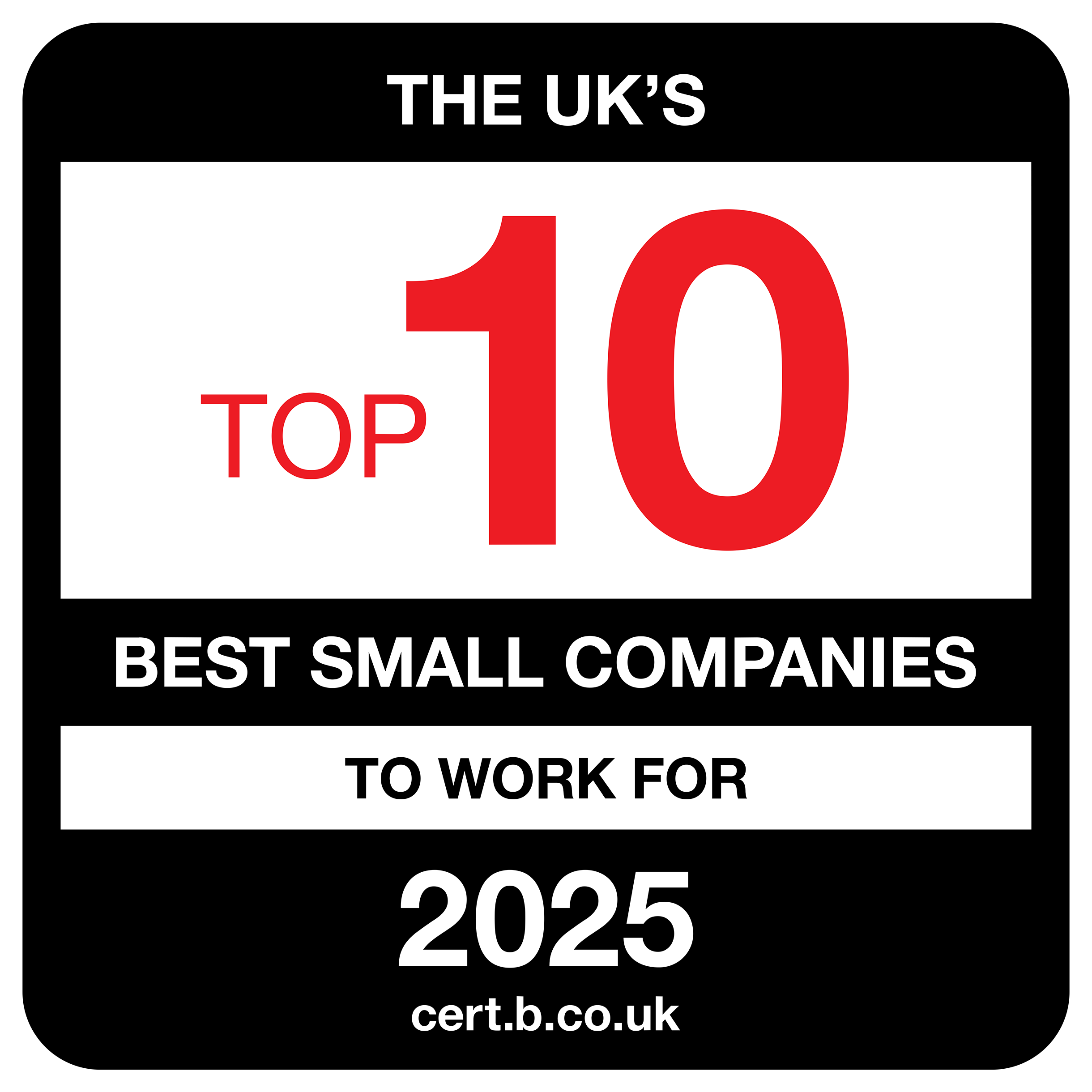
In 2025, Warranty First were ranked the 10th Best Small Company to Work For in the UK. Top 10 in the East of England. Top 5 in the Financial Services sector. And 3 Star accredited by Best Companies, the highest rating available.
At that point they had around 75 employees, no HR department, and no engagement platform.
The interesting part was never the awards. It was that they waited two years before entering, and then got there without buying anything.
The bit nobody puts in the press release
Most SMEs approach Best Companies the way people approach a gym in January. They sign up, run the b-Heard survey immediately, collect a Ones to Watch or a 1 Star, feel mildly deflated, and quietly do not enter again.
Warranty First's COO at the time wanted accreditation from the day High Performing HR started working with them in 2022. They did not run their first survey until 2024.
Two years of unglamorous groundwork first. Contracts, policies, pay structure, management capability, induction, the whole plumbing. Only then the survey.
That sequencing is the entire case study. Everything below is detail.
What is Best Companies accreditation, and what do the stars mean?
Best Companies has measured workplace engagement in the UK for 25 years. Employees complete an anonymous survey called b-Heard, covering eight factors: Leadership, My Manager, My Company, Personal Growth, Wellbeing, Fair Deal, My Team, and Giving Something Back.
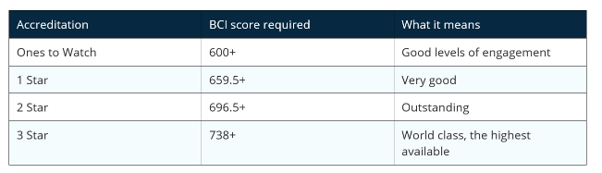
Responses generate a Best Companies Index (BCI) score on a 0 to 1,000 scale, and the score sets the accreditation:
Best Companies scoring
World class, the highest available
Three is the ceiling. There is no 4 Star and no 5 Star, whatever you have seen on somebody's email footer.
The results, year on year
Best companies score 2024 vs 2025
2024: fourteen points from world class
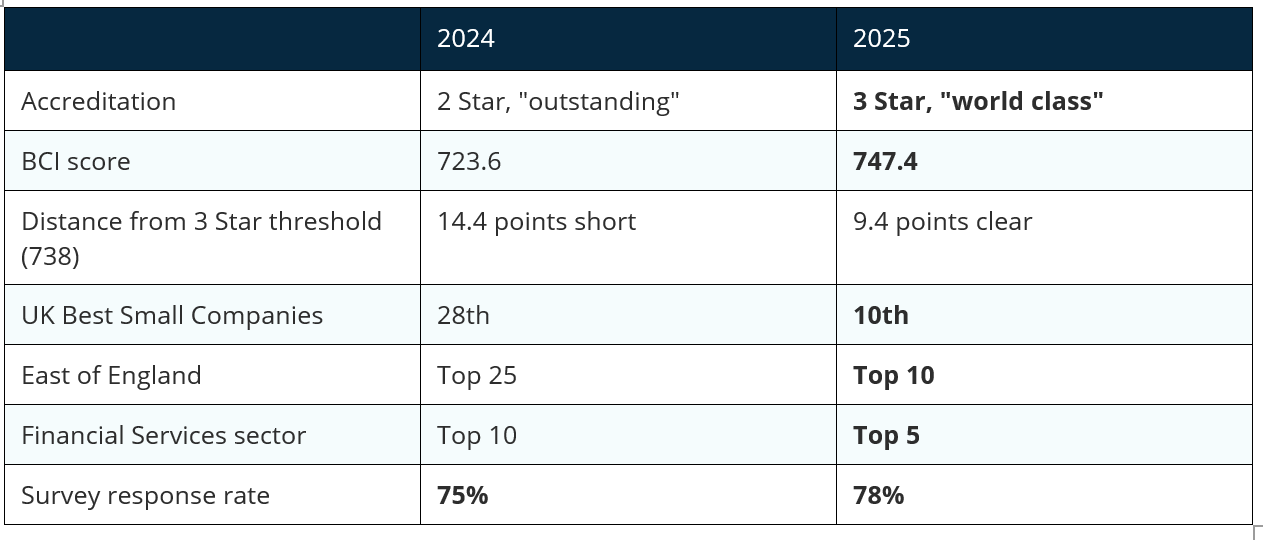
Warranty First scored a BCI of 723.6 on their first ever b-Heard survey. That is 2 Star, officially "outstanding", 27 points clear of the 2 Star threshold, and 28th Best Small Company in the UK. As debuts go, it was an extremely good one.
Then we did the arithmetic that most businesses skip.
Three Star starts at 738. Warranty First were 14.4 points short. Not a different league. Not a five year plan. Fourteen points.
That reframes everything. A gap that size is not a matter of culture or luck or hiring better people. It is a measurable delta, and a BCI score is built from eight factors you can look at individually. So instead of ordering the plaque, we went through the factor breakdown line by line to work out precisely where those fourteen points were hiding.
The factor breakdown made it obvious. Warranty First's two weakest factors in 2024 were Fair Deal and Giving Something Back, both sitting well below the rest of the profile. Meanwhile My Team was already strong.
Most engagement programmes go after the strong scores, because it feels good and the numbers move easily. We did the opposite. The points were in the floor, not the ceiling.
2025: 747.4, 3 Star, and 10th in the UK
The second survey returned a BCI of 747.4, clearing the 738 threshold for 3 Star with 9.4 points to spare.
That is a gain of 23.8 BCI points in twelve months. They needed 14.4 and found 23.8, which is the difference between hitting a target and clearing it properly.
The response rate was 78%, and that number deserves more attention than it usually gets. Response rate is itself an engagement signal. When more than three-quarters of your workforce voluntarily tell you how they feel about their employer, they have answered the question before you read a single line.
Best Companies' published profile of Warranty First from that year singled out three standout factors: My Team, Leadership, and My Manager.
That last one is not an accident.
Where the 23.8 points came from
Here is the year-on-year movement across all eight b-Heard factors, measured on the Best Companies 1 to 7 scale:
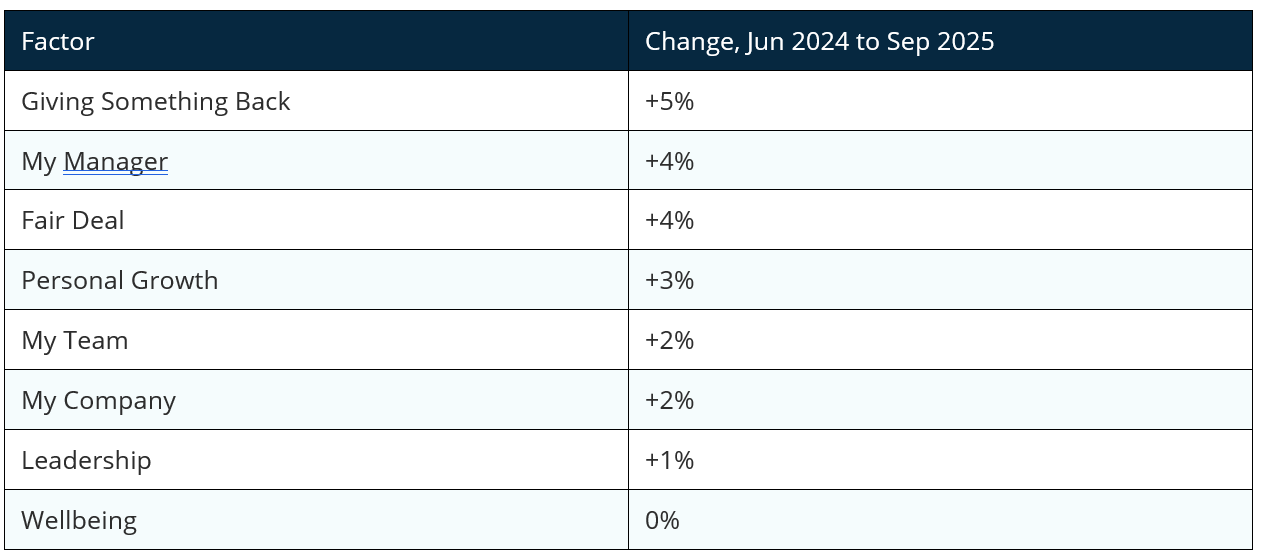
Seven factors up. One flat. And the pattern is the whole point.
The three biggest gains landed on Fair Deal and Giving Something Back, which were the two lowest-scoring factors in 2024, and on My Manager, which is consistently the highest-correlation factor in b-Heard data. My Team, already the strongest factor in the profile, moved the least.
That was deliberate. Engagement programmes usually chase the factors that are already good, because the wins come easily and the graphs look nice. But a BCI score is an aggregate, and aggregates are dragged down by their weakest components. Lifting a factor from 4.6 to 4.8 does more for your total than pushing an already excellent 5.9 to 6.0.
Lift the floor. The ceiling looks after itself.
The one that did not move
Wellbeing scored 0% change. Flat.
Support was in place. Employee assistance, mental health provision, the lot. But the data was clear that availability of support is not the same thing as work feeling manageable, and no amount of wellbeing benefit will fix a workload problem.
That gap was flagged in the 2025 analysis as the priority for the following cycle, alongside a wider warning that engagement was stable but plateauing. Three Star is not a finish line. It is a benchmark, and benchmarks have to be held.
What actually moved the numbers
1. Managers were trained to manage
The My Manager factor is the heaviest lever in most b-Heard datasets, because a person's direct manager shapes their experience of personal growth, wellbeing and fair treatment far more than any company-wide initiative does.
It is also one of the cheapest factors to move, because poor management is rarely malice. It is usually somebody promoted for being excellent at the job, handed six direct reports, and given a shrug and a login.
We built and delivered a management and leadership programme in-house for ten managers over two years. Bite-sized and practical, not a residential with a flipchart. The curriculum covered:
• The right to manage, and the employment law context around it
• Giving feedback
• Absence and wellbeing
• Managing performance
• Emotional intelligence
• Equality, diversity and inclusion
Ten managers for around 75 staff is roughly one manager per seven people, which is the shape most growing SMEs are in. Nobody was taken off the job for a week. The sessions were short, spread out, and immediately applicable, which is why they were actually attended.
No offsite. No ropes course. Just managers being shown how to do the job they had already been given.
2. Nothing new was bought
There is no engagement platform in this story. No Culture Amp, no Peakon, no pulse survey app, no wellbeing portal with a disappointing login rate. Across two years, Warranty First did not purchase a single new piece of engagement technology.
What they did instead was use what they were already paying for.
The b-Heard report became the diagnostic. A Best Companies report contains factor scores, a ranking of your fifteen most highly correlated questions, heatmaps showing the spread of positive, neutral and negative responses, and team-level variation. That is a full diagnostic. Most organisations receive it, look at the headline BCI number, check which star they got, and file it. Every intervention in the following twelve months was chosen because the data said it would move the score, not because it seemed like a nice idea.
The recognition function already sat inside their HR system. Warranty First were using BrightHR, which includes a Kudos feature for peer-to-peer recognition. It was already there, already paid for, and barely used. Switching it on properly cost nothing.
Communication channels were tightened up. Not a new intranet. Clearer, more frequent, more visible internal communication, with decisions explained rather than announced.
That combination was deliberate, and it came straight out of the data. The most useful finding in the report was not the negative responses. It was the neutrals. A large block of neutral answers does not mean people are unhappy, it means they are unconvinced, uninformed, or have not noticed. Neutrals suppress a BCI score just as effectively as negatives, and they are considerably cheaper to shift, because the fix is communication, recognition and visibility rather than structural change.
Most engagement budgets get spent solving the wrong problem, because negativity is loud and neutrality is silent.
3. The structural work, done before the survey
This is the part that takes two years and never makes the LinkedIn post:
• Starting salaries raised across all roles in response to the cost of living crisis, which moved the Fair Deal conversation from defensive to honest
• A proper induction, with remote starters spending their first week in the office learning from peers and managers rather than from a PDF
• Team building days and evenings, deliberately mixing teams that do not normally overlap
Contracts and policies updated to not only be legally compliant but reflect the culture.
• Partnership with community interest groups to create routes into work for young people who had fallen out of education
That last one feeds the Giving Something Back factor, which most SMEs forget exists until it drags their score down.
What else changed
• Staff Turnover dropped, even in a sales environment which is notoriously high
• Higher calibre candidates walking through the door
At the time of the 2025 result, Warranty First also held a 5.0 average across 34 Glassdoor reviews, which was the same story told by people nobody had asked nicely.
‘This is an incredible achievement and something every single team member should be very very proud of. Without our people, there is no business, and there is certainly no Team. It’s an honour for me to work alongside such a talented, dedicated, and brilliant team. It’s also no surprise to me that a team capable of creating a World Class workplace continues to deliver world class results as well.’ - Charlie Whiston, Warranty First CEO
Six things that made the difference
1. They did not enter until they were ready. Two years of infrastructure before the first survey. Most businesses do it the other way round and then wonder why the score is disappointing.
2. The gap was measured, not guessed at. Fourteen points from 3 Star is a number you can work backwards from. Most businesses never calculate it, so 3 Star stays an aspiration rather than a plan.
3. They lifted the floor, not the ceiling. The biggest gains went to the two weakest factors. Aggregates are dragged down by their worst components, so that is where the points are.
4. Managers were fixed before anything was bought. Software will not rescue a line manager who has never been shown how to run a one-to-one. It will just give them another tab to ignore.
5. Pay was dealt with honestly. You cannot train your way out of a Fair Deal problem, and Fair Deal was the lowest-scoring factor in 2024.
6. The loop was closed, visibly. Staff were told what the survey said, what was changing, and by when. Nothing kills a response rate faster than a survey that vanishes into a drawer.
Frequently asked questions
Can a small company get 3 Star Best Companies accreditation?
Yes. Accreditation depends entirely on the BCI score from the b-Heard survey, not on headcount, revenue, or budget. Warranty First achieved 3 Star with around 75 employees and no HR department. Smaller organisations often have an advantage, because leadership visibility and team cohesion score well when there are fewer layers to hide behind.
How long does it take to get Best Companies accredited?
Warranty First spent two years building before their first survey in 2024, took 2 Star, and reached 3 Star in 2025. Moving up a full star level in a single survey cycle is fast. A more common path is Ones to Watch, then 1 Star, then 2 Star over three years.
What is a good BCI score?
Over 600 earns Ones to Watch. 659.5 earns 1 Star, 696.5 earns 2 Star, and 738 or above earns 3 Star, the highest accreditation available. Warranty First scored 723.6 in 2024 and 747.4 in 2025, a gain of 23.8 points.
How many BCI points do you need to move up a star level?
It depends where you start. The gap from 2 Star to 3 Star is 41.5 points at the thresholds, but most organisations sitting at 2 Star are already partway across it. Warranty First were 14.4 points short in 2024 and gained 23.8 in one cycle. Calculate your actual distance before deciding whether the next star is realistic.
Should you run the b-Heard survey straight away?
Usually not. If your contracts, pay structure, policies and management capability are not in order, the survey will simply document that in detail. Fix the foundations, then measure.
Do you need an HR department to get Best Companies accredited?
No. Warranty First did it without one. What you need is somebody accountable for interrogating the data properly, and somebody credible enough to tell the leadership team things they would rather not hear.
Do you need an employee engagement platform to improve your scores?
No. Warranty First reached 3 Star and 10th in the UK without buying any new engagement technology across two years. They used the b-Heard report they had already paid for as a diagnostic, and switched on the peer recognition function already sitting unused inside their existing HR system. A platform generates more data. It does not interpret the data you already have, and interpretation is usually the missing step.
Which b-Heard factors should you focus on first?
Your weakest ones, in most cases. The BCI is an aggregate, so it is held down by its lowest components. Warranty First's biggest gains came from Fair Deal and Giving Something Back, their two lowest-scoring factors in 2024, plus My Manager, which correlates most strongly with overall engagement. Their strongest factor, My Team, moved the least and it did not matter.
Does management training actually move engagement scores?
It is usually the highest-return intervention available, because the My Manager factor influences several of the others. By 2025, My Manager was one of the three factors Best Companies singled out in Warranty First's public profile.
What does Best Companies accreditation cost?
Best Companies charges for the b-Heard survey and accreditation directly, priced by headcount. Current rates are at b.co.uk. The bigger cost is almost always the work you do in response to the results.
Got a b-Heard report you have not properly read?
Most 2 Star companies are closer to 3 Star than they think. In 2024, Warranty First were 14.4 points away and did not know it until somebody did the arithmetic.
The report Best Companies sends you contains everything you need: factor scores, correlation rankings, heatmaps, team-level variation. What it does not contain is a decision about what to do on Monday.
The Points Gap Review is a fixed-fee analysis of your b-Heard results. You send the report. We come back with:
• Your exact distance from the next accreditation level, in BCI points
• Which factors are actually holding you back, ranked by drag on your score rather than by how bad they look
• Which of your highest-correlation questions will shift most cheaply
• Where neutral responses are suppressing your score, and what fixes those
• A twelve month roadmap with owners, sequencing, and success measures
No retainer required. No commitment beyond the report.