
On International Women’s Day I went to a protest instead
On International Women's Day, tokenism, and why I took to the streets.
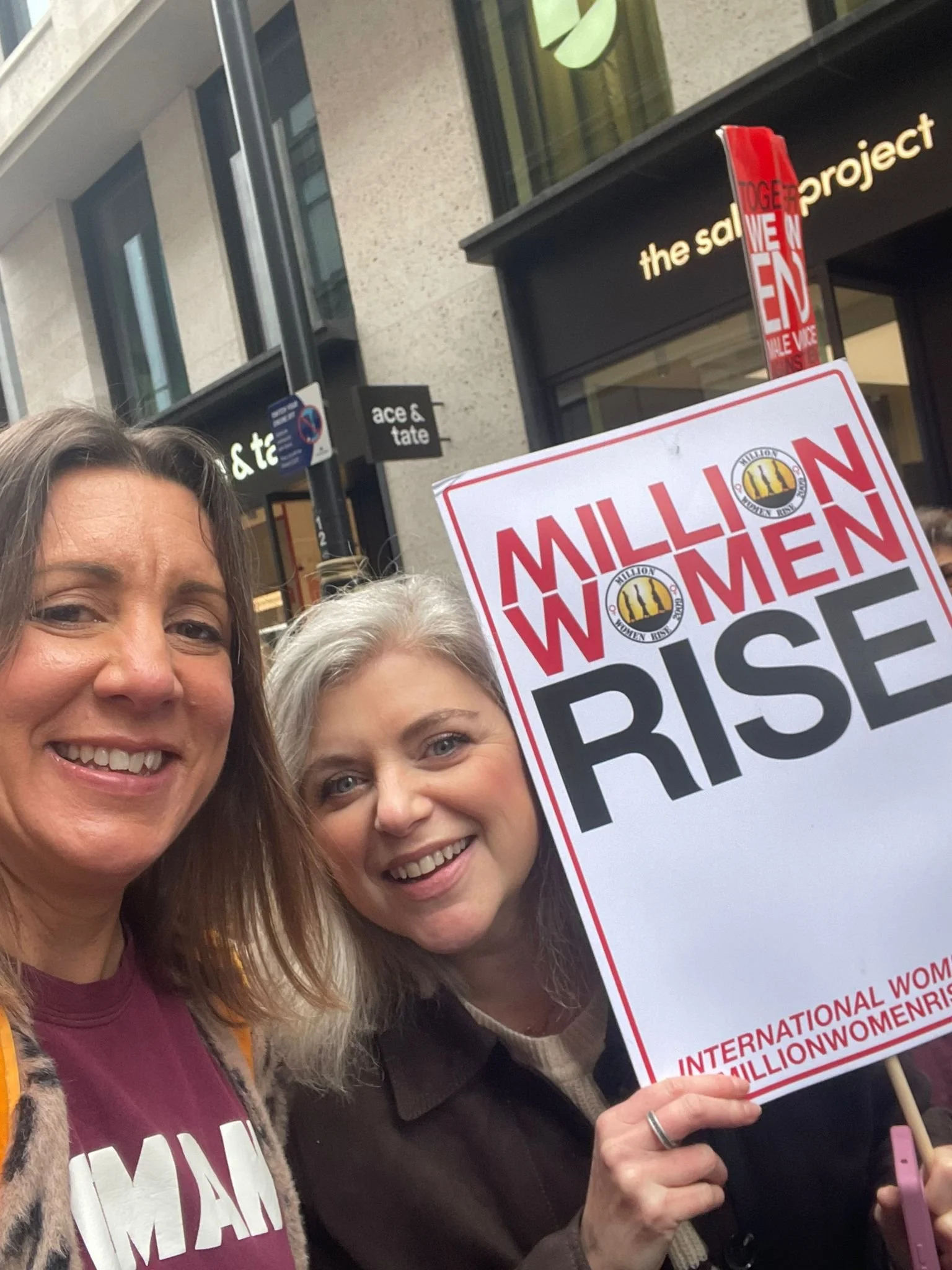
HPHR Founder Siobhan Godden and her friend Laura Hood at the Women’s Rights March
I went with my best friend of thirty years. She works at board level with angel investors, specifically backing female-founded start-ups, spending her days making sure women with brilliant ideas can actually get them off the ground. Between the two of us, we probably spend more time thinking about women's progression in the workplace than is entirely healthy. And yet there we were, on a Saturday, in the street, because sometimes that's what it takes.
Thousands of women filled the streets of London for Million Women Rise, a march against male violence, far-right misogyny, and the very real rollback of women's rights happening right now, in real time, across the globe. It was loud. It was angry. It was exactly what International Women's Day was always supposed to look like.
And yet, back in the warm corporate glow of the internet, the official IWD machine was busy asking women to make a giving gesture with their hands.
I'm not joking.
What IWD Was Actually Born From
Here's the thing that gets quietly airbrushed out every March: International Women's Day was not founded by a wellness brand. It was born from the streets.
In 1908, hundreds of women from New York's needle trade marched through Manhattan's Lower East Side demanding the right to form unions and the right to vote. These were immigrant women working brutal hours in dangerous conditions. Two years later, German socialist Clara Zetkin proposed an International Women's Day at a socialist conference in Copenhagen, a day explicitly rooted in the fight for working-class women's political and economic equality.
A million people marked the first IWD in 1911. They marched. They demonstrated. They demanded. In 1917, it was International Women's Day protests by Russian textile workers that became the flashpoint for the Russian Revolution; women demanding bread, peace, and basic dignity.
The United Nations didn't even officially recognise it until 1975. By then, the socialist feminist origins had already started being quietly forgotten.
And now? We have a hand pose and a hashtag.
Please Sir, Can I Have Some More?

International Women’s Day theme 2026
The official IWD 2026 theme is 'Give to Gain.' The flagship action? Strike a pose with cupped, outstretched hands to show solidarity.
Let that sink in.
Women, who have been fighting for their rights for well over a century, are being asked to stand with their hands open like a begging bowl and call it activism. Oliver Twist had more dignity, and at least he knew who the villain was.
The symbolism is excruciating. Cupped hands have historically meant one thing: supplication. Asking. Waiting to receive. And that, in miniature, is exactly what's wrong with the sanitised, corporate version of IWD. It frames women as grateful recipients of men's generosity rather than people whose rights are being actively, deliberately, and systematically stripped from them.
It is not a call to action. It is a call to patience. And women have been patient long enough.
Look at the World We're Actually Living In
Let's talk about the world in which we're being asked to perform this begging pose.
In Afghanistan, women have been erased from public life entirely; banned from schools, from work, from leaving the house unaccompanied, from existing in any meaningful way outside four walls. They are legally invisible. The international community watched it happen and largely moved on.
The Epstein files have reminded us (in nauseating, extensively documented detail) just how many powerful men knew about, enabled, and participated in the systematic abuse of girls and young women, and faced nothing for it. The victims waited decades for justice they are still being denied. And the men who attended those parties, those islands, those flights? Still in their boardrooms. Still at their galas. Still being celebrated.
Closer to home, Reform has floated the idea of taxing women who don't have children, treating female bodies as a national resource to be managed, incentivised, and penalised by the state. Because apparently the problem isn't the cost of childcare, the gender pay gap, or the lack of flexible working. The problem is women making the wrong choices with their own bodies. Not to mention those women who have desperately tried for children and unable to, what about them?
Meanwhile, tech billionaires publicly wring their hands about falling birth rates (as though women are a production problem to be solved) while building the AI systems that will displace millions of women from the workforce entirely. And on social media, the ultra-thin body trend is back with a vengeance: ribcages and thigh gaps algorithmically amplified to teenage girls for engagement. Starvation aesthetics, monetised and served at scale. Ensuring females are weakened.
This is the world. This is the context. This is what women are navigating every single day. And the official IWD response is to ask us to hold out our hands and hashtag it.
I'm sorry, but no.
The Corporate Capture of IWD
I work in HR. I've spent years helping organisations think seriously about equality, diversity, and inclusion. I believe that workplace culture genuinely matters. But I've also watched International Women's Day become something that makes me wince.
Every year, the same cycle: a purple-tinged email from the CEO. A breakfast event with a panel of senior women. A social post where someone has found a clever way to make their logo look feminist for 24 hours. McDonald's famously flipped its arches to a 'W' for IWD, while continuing to underpay the women who work in its restaurants. The symbolism arrived. The substance did not.
Tokenism isn't just ineffective. It's actively harmful. It creates the impression that action has been taken when it hasn't. It allows organisations to absorb and neutralise feminist energy rather than respond to it. It shifts the conversation away from accountability — from pay gaps, flexible working, safety at work, representation in leadership — and toward aesthetics.
It turns a day that was originally about collective power into a day about individual inspiration. And inspiration, whilst lovely, doesn't close a gender pay gap.
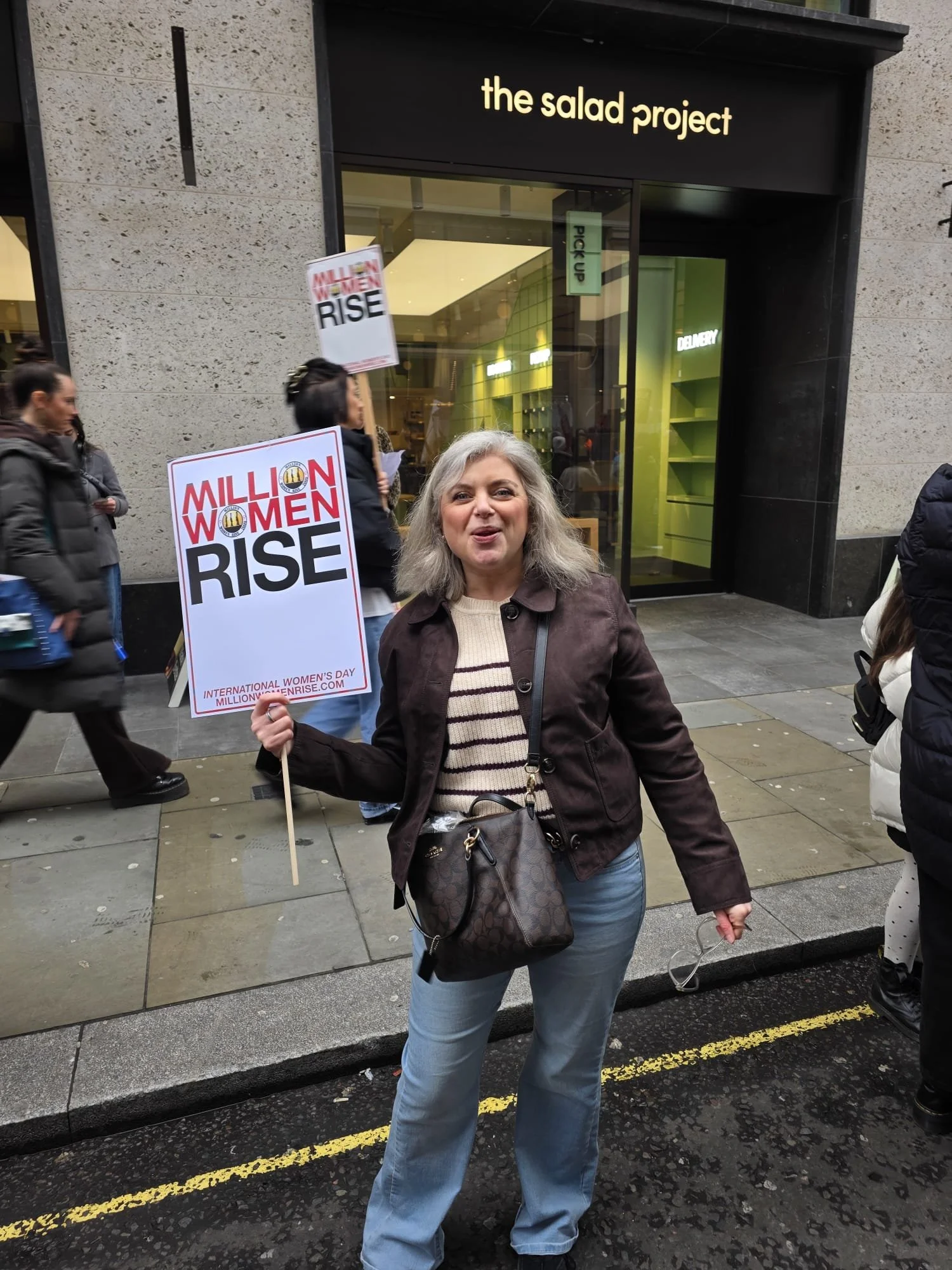
Why I Marched
Million Women Rise is an annual march through London held as close to International Women's Day as possible. This year, it felt more urgent than it has in a long time. We are living through a moment of organised, emboldened, mainstream misogyny — from online radicalisation pulling young men toward ideologies that openly dehumanise women, to political parties treating women's bodies as a fiscal policy question.
Being there, in the crowd, surrounded by women and girls of all ages, backgrounds, and convictions, holding signs and making noise and taking up space , felt like the most honest way to mark the day. Not performative. Not palatable. Not a pose.
That, to me, is the spirit of International Women's Day. It was never meant to be comfortable.
So What Do We Actually Do?
I'm not here to tell you that every IWD event is worthless, or that you're a bad feminist if you went to a breakfast panel. Raising awareness matters. Conversations matter. Visibility matters.
But this is my challenge to you , for the rest of this year, not just today:
✦If you're an employer: run your gender pay gap analysis and actually publish it. Then do something about it.
✦If you're in HR: look at your flexible working policies, your parental leave, your promotion data. Who's being left behind and why?
✦If you're an individual: find the thing that feels slightly uncomfortable and do that. Attend a march. Challenge a microaggression. Call out the panel where all the speakers are men.
✦And perhaps most importantly: stop conflating visibility with progress. A purple logo is not a policy. A hand pose is not a movement.
✦And to the good men: the ones who show up, who speak up, who use their privilege as a lever rather than a shield. To our husbands who are helping us raise the next generation to do the same, thank you. Genuinely. Thank you to all the partners, fathers, and sons. Now bring a friend next year!
IWD belongs to the women who marched through the snow in 1911 demanding the right to vote. It belongs to the textile workers of Petrograd who helped bring down a tsar. It belongs to the women in London this weekend who refused to be polite about male violence, about far-right misogyny, about a world that still — still — treats women's safety and autonomy as negotiable.
It doesn't belong to a begging bowl.